The best telc B1 exam tips come from telc's own rules: book your date early, practise the 90-minute reading and Sprachbausteine block in one go, spend time on the questions worth 5 points, mark the answer sheet carefully, answer all four points in the email, and reach 60% in both the written and the oral exam.
PassGerman is built by German teacher Ramin A., who has taught more than 1,000 lessons on Preply. Every tip below is tied to a page in telc's official practice test or to our own check of 64 exam centers. The general overview lives in our German B1 exam guide. This page is the playbook.
| Part | Questions | Each | Total |
|---|---|---|---|
| Reading 1 + 2 | 5 + 5 | 5 | 50 |
| Reading 3 | 10 | 2.5 | 25 |
| Sprachbausteine | 10 + 10 | 1.5 | 30 |
| Listening 1 + 3 | 5 + 5 | 5 | 50 |
| Listening 2 | 10 | 2.5 | 25 |
| Writing | 1 email | up to 45 | 45 |
| Written exam | 225 |
On this page
- What each question is worth
- Tip 1: Book your exam date first
- Tip 2: Practise the 90 minutes in one go
- Tip 3: Spend time where the points are
- Tip 4: In reading part 3, some people get nothing
- Tip 5: Listening part 1 plays only once
- Tip 6: Practise the answer sheet
- Tip 7: Answer all four points in the email
- Tip 8: In speaking, talk to your partner
- Tip 9: Respect both pass marks
- Tip 10: Sit full mock exams under time
- FAQ
What each telc B1 question is worth
Not every telc B1 question is worth the same: a question in reading parts 1 and 2 or listening parts 1 and 3 is worth 5 points, while a Sprachbausteine gap is worth 1.5. telc gives each part a fixed number of points, and the parts have different numbers of questions (Übungstest 1, page 39).
So one listening question in part 3 is worth more than three grammar gaps. Nobody prints that on the exam paper, which is a shame, because it's the most useful number in the building.
Tip 1: Book your exam date before you plan your preparation
Book the date first, then plan backwards, because telc B1 dates book out and every center sets its own deadline. When we checked 64 centers in September 2026, centers in Munich, Frankfurt, Hanover and Düsseldorf showed telc B1 dates as fully booked.
| What we found at 64 centers | September 2026 |
|---|---|
| Full exam fee | €150 to €235, about €198 in the middle |
| Registration deadlines | From 9 days to about a month before the exam |
| Dates marked fully booked | Munich, Frankfurt, Hanover, Düsseldorf |
| Results | 3 to 8 weeks, most centers say 4 to 6 |
Fees ranged from €150 to €235 at the 32 centers that publish a price. Our telc B1 exam centers overview lists fees and deadlines city by city. A date in the calendar also has a wonderful effect on motivation. It turns "I should practise" into "I have eleven Saturdays left".
Tip 2: Practise the 90-minute block in one go
Reading and Sprachbausteine share one 90-minute block with no break, so practise them together, not separately. You get 40 questions in a row: 20 reading, 20 Sprachbausteine (Übungstest 1, page 29).
| Written exam, in order | Time | Points |
|---|---|---|
| Reading + Sprachbausteine | 90 min, no break | 105 |
| Listening | about 30 min | 75 |
| Writing (email) | 30 min | 45 |
If you've only ever practised reading on a quiet Sunday with a coffee, the real block will feel very different. The coffee isn't allowed, for one.
Tip 3: Spend your time where the points are
Reading and listening are worth 150 of the 225 written points, so they deserve most of your practice time. Sprachbausteine are only 30 points, and every gap is worth 1.5.
- Reading: 75
- Sprachbausteine: 30
- Listening: 75
- Writing: 45
That doesn't mean skipping grammar. It means not spending ten minutes on one Sprachbausteine gap while a 5-point reading question sits there unanswered. If a gap won't open, make a choice, mark it and come back at the end. Our Sprachbausteine guide shows how to make that choice faster.
Tip 4: In reading part 3, some people get no ad at all
In reading part 3 you match 10 people to ads, and for some of them no ad fits: then the answer is x. In telc's practice test, 2 of the 10 answers are x (Übungstest 1, page 41).
Learners often force a match because an empty answer feels like failure. Resist it. Sometimes the right answer really is "nobody here can help this person", which, to be fair, is also the most realistic outcome of any German classifieds section.
Tip 5: Listening part 1 plays only once
In listening part 1 you hear five short texts only once. Parts 2 and 3 play twice. Before part 1 starts you get 30 seconds to read the five statements (Übungstest 1, pages 14 to 16).
| Listening | Qs | Played | Each |
|---|---|---|---|
| Part 1 | 5 | once | 5 |
| Part 2 | 10 | twice | 2.5 |
| Part 3 | 5 | twice | 5 |
Use those 30 seconds to underline the key word in each statement: who does what, when. Then listen for that and nothing else. Part 1 is 25 points for maybe four minutes of audio, the best hourly rate in the whole exam.
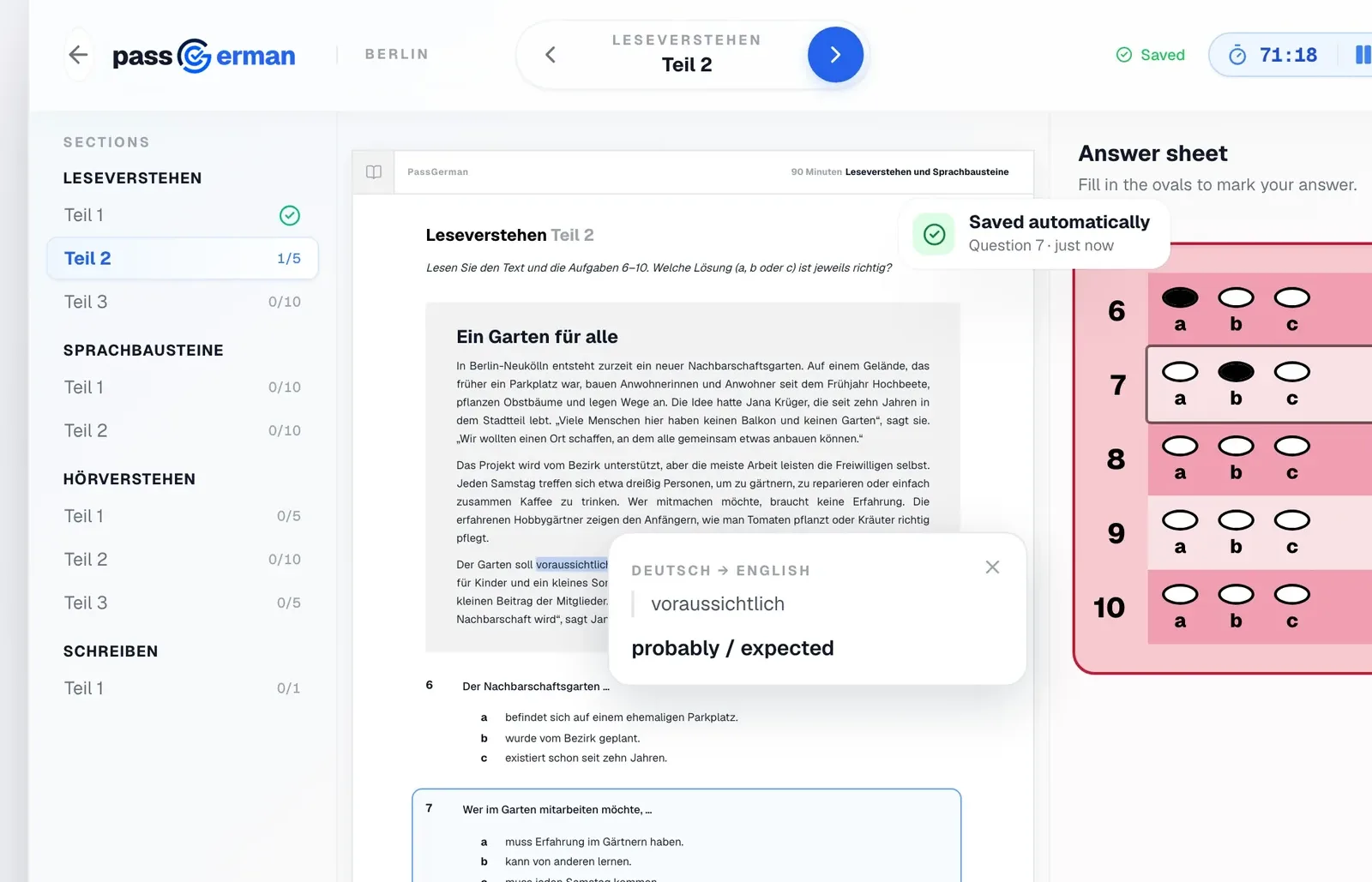
Tip 6: Practise filling in the answer sheet
Only clearly marked fields on the answer sheet are scored, and every sheet is scanned by machine. telc recommends a soft pencil for the ovals (Übungstest 1, pages 28 and 40).
The reading and Sprachbausteine page of the answer sheet is collected when the 90 minutes end. If your answers are still in the task booklet then, they stay there. Transfer as you go, or set a hard stop at minute 80. A scanner has never once accepted "but I knew it".
PassGerman's free mock exam has reading, Sprachbausteine, listening with audio and writing under the real time limits. You see your points for each part at the end.
Start a free mock examTip 7: Answer all four guiding points in the email
The writing task is one email with four guiding points, and missing one costs 6 of the 45 points straight away. Raters also mark you down if most sentences start with "Ich" or if you switch between du and Sie (Übungstest 1, pages 36 to 38).
Our telc B1 writing tips walk through the full scoring grid, and our B1 letter examples show five marked letters.
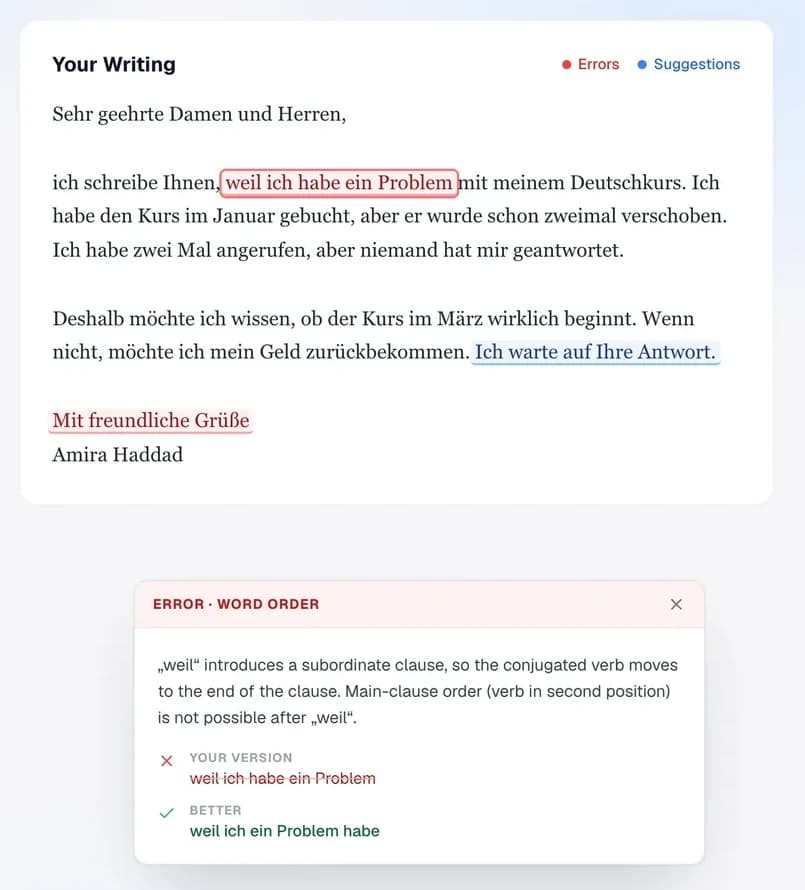
Number the four points on your scrap paper. Tick them off. Feel slightly silly. Get the points.
Tip 8: In the speaking exam, talk to your partner, not the examiner
The oral exam is a conversation with another candidate, and asking follow-up questions and helping each other is scored positively. The examiners stay mostly out of it and only step in if one person dominates or goes quiet (Übungstest 1, page 31).
You get 20 minutes to prepare, and notes are only allowed on the stamped sheets the center hands out. You can take them in, but you shouldn't read from them (page 30).
Think of your partner as a stranger at a bus stop you suddenly need to plan a party with. Ask them things. They're just as nervous.
Tip 9: Respect both pass marks, not just the total
You need 60% in the written exam and 60% in the oral exam separately: 135 of 225 and 45 of 75 points. A strong oral score can't rescue a weak written one (Übungstest 1, page 40).
- Written needed: 135
- Written buffer: 90
- Oral needed: 45
- Oral buffer: 30
One test-taker on Reddit scored 72 of 75 in speaking and still failed, because the written part came to 113.5. Reading was 25 of 75. The full breakdown of what counts, and what each grade needs, is in our telc B1 passing score guide.
Tip 10: Sit full mock exams under the real clock
The most common thing in success stories is volume: full practice exams, timed, many of them. One test-taker did about 23 practice tests in four weeks and passed. Another passed in under a month while working full-time with two young kids.
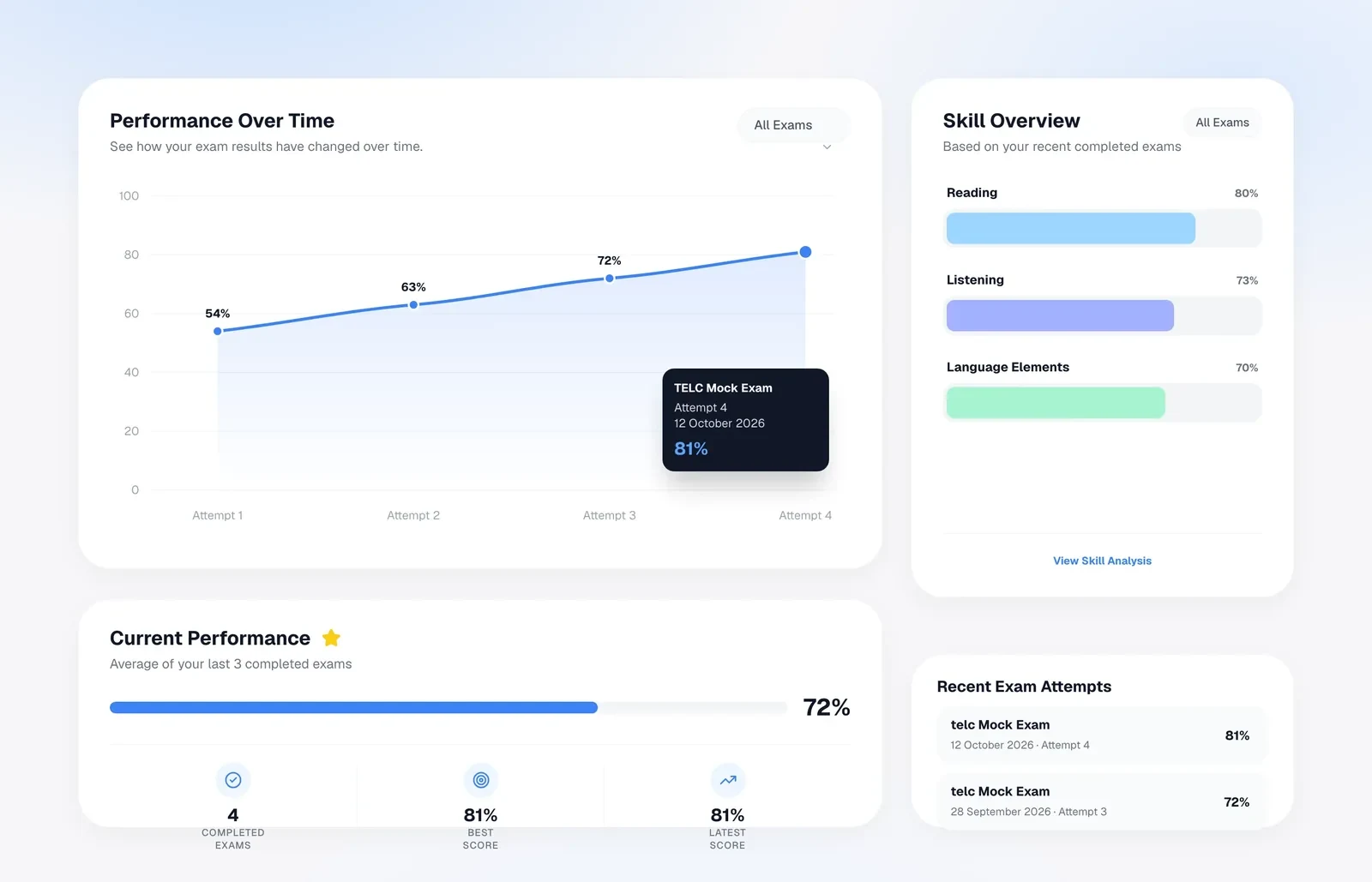
A timed mock exam shows two things a textbook never will: where your points actually come from, and how your brain behaves at minute 140. Ours keeps every attempt, so you can see the line move.
FAQ
How long should I prepare for the telc B1 exam?
It depends on where you start. If your German is already around B1, four to eight weeks of focused practice with full mock exams is a common plan. One test-taker on Reddit prepared for four weeks and did about 23 practice tests.
Which part of the telc B1 exam is the hardest?
It differs by person, but reading and listening carry the most points: 75 each of the 225 written points. A weak reading score is the most common reason a written result falls short of 135.
Can I use a dictionary in the telc B1 exam?
No. Dictionaries, phones and other electronic devices aren't allowed in the written or the oral exam, including the 20 minutes of speaking preparation.
Do wrong answers cost points in telc B1?
The telc marking guide gives points for correct answers and says nothing about deductions for wrong ones. So never leave a question blank: a guess can only help.
What happens if I fail one part?
You only repeat the part you failed, written or oral, in the same or the following calendar year. The result of the retake replaces the old one.
Want a structured plan for all of this? Our telc B1 exam practice page shows how PassGerman trains every written part, or start with the free B1 mock exam and see where you stand tonight.