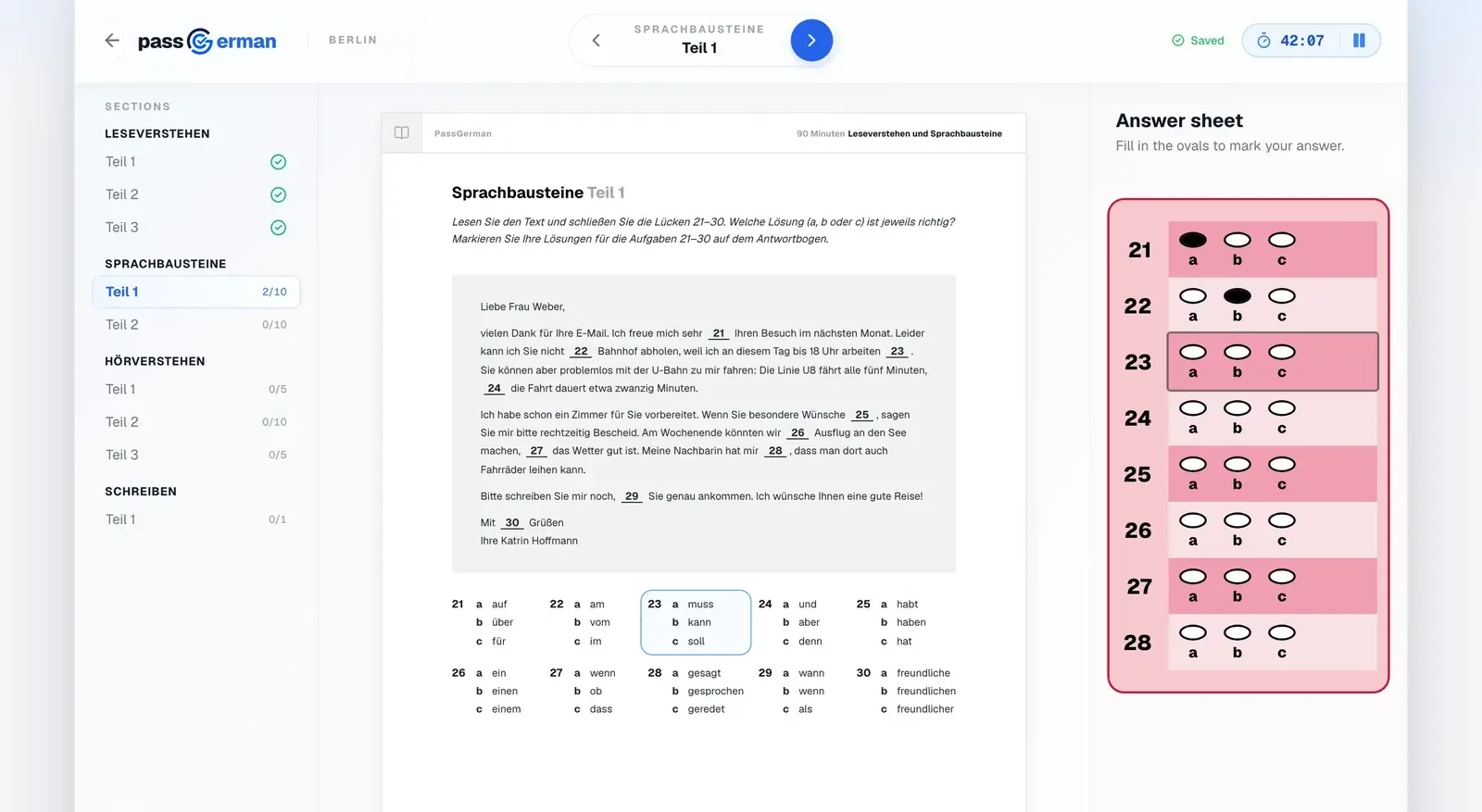
Sprachbausteine are the grammar and vocabulary part of the telc B1 written exam: two gap-fill texts with 10 gaps each, worth 30 of 225 points. In part 1 you choose a, b or c for each gap. In part 2 you fill 10 gaps from a list of 15 words, each word used once. They share one 90-minute block with reading, and each gap is worth 1.5 points.
PassGerman is built by German teacher Ramin A., who has taught more than 1,000 lessons on Preply. For this guide we took apart both Sprachbausteine texts in telc's official practice test, gap by gap, to see what they actually test. Spoiler: it's the same handful of grammar points, wearing different hats. The whole exam is explained in our German B1 exam guide.
| Part 1 | Part 2 | |
|---|---|---|
| Gaps | 10 (questions 21 to 30) | 10 (questions 31 to 40) |
| Task | Choose a, b or c | Choose from 15 words, a to o |
| Mainly tests | Grammar | Vocabulary and word choice |
| Points | 15 (1.5 per gap) | 15 (1.5 per gap) |
| Text type in the practice test | Informal letter to a friend | Formal enquiry to a holiday pension |
On this page
What are telc B1 Sprachbausteine?
Sprachbausteine ("language building blocks") test whether you can complete a German text correctly: the right grammar in part 1, the right word in part 2. They come straight after reading, inside the same 90 minutes, with no break in between (Übungstest 1, page 29).
Both texts in the practice test are letters. That's good news: you'll write one yourself an hour later, so every connector you learn here pays twice. It's the only bulk discount the exam offers.
Sprachbausteine part 1: choose a, b or c
Part 1 is a short letter with 10 gaps, and for each gap you choose one of three options. In the practice test, every one of the 10 gaps checks a different grammar point (Übungstest 1, page 12).
| Gap | Options | What it tests |
|---|---|---|
| 21 | aber · denn · sondern | Connector: contrast |
| 22 | eine · einen · einer | Article after a preposition (dative) |
| 23 | bin · habe · wurde | Perfect tense: sein or haben |
| 24 | anstrengend · anstrengende · anstrengendes | Adjective after sein (no ending) |
| 25 | trotzdem · wegen · weshalb | Connector: concession |
| 26 | bis · in · nach | Preposition of time |
| 27 | gelernt · lernen · lernte | Verb form in the perfect tense |
| 28 | dem · denen · die | Relative pronoun after a preposition |
| 29 | meine · meinen · meiner | Possessive in the dative plural |
| 30 | dir · Ihnen · uns | Pronoun: who you're writing to |
Look at the options and you can often name the topic before you read the sentence. Three forms of one article means case, three connectors means logic.
It's a bit like knowing which relative is calling before you pick up the phone.
How to solve Sprachbausteine part 1
Read the whole sentence, find the word that controls the gap, then check case, verb position or logic. Two gaps from the practice test show how this works.
| If the options are | Check this first |
|---|---|
| Three forms of an article or ending | The case: what comes before the gap (bei, mit, für, the verb) |
| Three connectors | Logic and verb position: contrast, reason or result? |
| Three verb forms | Tense and the verb already in the sentence (haben or sein?) |
| Three pronouns | Who is writing to whom: du or Sie, singular or plural |
Gap 21: "Wie du ja weißt, wollte ich eigentlich nach Paris, ___ das hat dann leider nicht geklappt." The second half contradicts the plan, and the verb stays in second position, so it's "aber". "Sondern" would need a "nicht" before it, and "denn" gives a reason, not a contrast. The answer key confirms a (page 41).
Gap 22: "eine Stelle als Praktikant bei ___ Firma". "Bei" always takes the dative, and Firma is feminine, so it's "einer". Ten seconds, 1.5 points, and a small moment of revenge on every dative that ever embarrassed you.
The free PassGerman mock exam puts both Sprachbausteine parts in the same 90-minute block as reading, like the real exam. Premium explains every answer, right and wrong.
Start a free mock examSprachbausteine part 2: one word list, ten gaps
Part 2 is a letter with 10 gaps and a box of 15 words, labelled a to o. Each word fits only once, so 5 words are left over. In the practice test, the text is a formal enquiry to a holiday pension (Übungstest 1, page 13).
| Word type | Words in the practice test box |
|---|---|
| Prepositions | mit, für |
| Connectors | da, damit, deshalb, wenn, schließlich |
| Adverbs | besonders, gerne, damals |
| Modal verbs | müssten, könnten |
| Other | dankbar, dafür, wann |
Grouping the box like this is the whole trick. Before you read a single gap, you know there are only two prepositions and five connectors on offer. The box stops being a cloud of words and starts being a short menu.
How to solve Sprachbausteine part 2
For each gap, decide first what kind of word is missing, then choose only from that group. Fill the gaps you're sure of first and cross those words out, so the list gets shorter as you go.
Gap 31: "ich interessiere mich sehr ___ Ihr Angebot". "Sich interessieren" always comes with "für", so it's h. Gap 40: "Außerdem wären wir Ihnen sehr ___" needs an adjective that goes with "sehr" and a polite request, so it's "dankbar", f (page 41).
Verbs with fixed prepositions turn up in both parts: sich interessieren für, sich freuen auf, warten auf, denken an. Learn them as pairs, the way you'd learn a phone number with its area code. On their own, half the number is useless.
How much time to spend on Sprachbausteine
telc gives no separate time for Sprachbausteine: the 90 minutes cover all 20 reading questions and all 20 gaps. You choose the split yourself, which sounds generous until minute 85.
| Minutes | What | Points |
|---|---|---|
| 0 to 60 | Reading parts 1 to 3 | 75 |
| 60 to 80 | Sprachbausteine parts 1 and 2 | 30 |
| 80 to 90 | Check and transfer to the answer sheet |
Some learners prefer Sprachbausteine first, to bank quick points while their head is fresh. Both orders work. What doesn't work is discovering the answer sheet at minute 89, which is a surprisingly popular choice.
What Sprachbausteine are worth in your result
Sprachbausteine are 30 of the 225 written points, the smallest part of the written exam, but they still decide results that end up a few points short. You need 135 written points to pass, and every gap is 1.5 of them.
| Test-taker | Sprachbausteine | Written | Result |
|---|---|---|---|
| Self-study, 4 months | 25.5 / 30 | 176 | Passed, gut |
| Failed written part | 18 / 30 | 113.5 | Not passed |
The 7.5-point gap between those two Sprachbausteine scores is five gaps. Not the reason the second person failed, since reading was 25 of 75, but nobody misses five free gaps in a close result and shrugs. How every point adds up is in our telc B1 passing score guide, and where to spend your practice time is in our telc B1 exam tips.
FAQ
How many points are the telc B1 Sprachbausteine worth?
30 of the 225 written points, which is 10% of the whole exam. Each of the 20 gaps is worth 1.5 points.
How long do I have for the Sprachbausteine?
There's no separate time limit. Reading and Sprachbausteine share one 90-minute block, so you decide how to split the time between the 40 questions.
Can I use a word twice in Sprachbausteine part 2?
No. In part 2 you choose from 15 words for 10 gaps, and each word fits only once. Five words are left over.
Is there a pass mark for the Sprachbausteine alone?
No. Sprachbausteine count towards the written exam, where you need 135 of 225 points in total. There's no separate minimum for this part.
What grammar comes up in telc B1 Sprachbausteine?
In telc's practice test, part 1 tests connectors like aber and denn, articles and endings after prepositions, haben or sein in the perfect tense, adjective endings, relative pronouns and possessives. Part 2 adds prepositions, adverbs, modal verbs and connectors like damit and wenn.
Ready to practise Sprachbausteine in the real format? Our telc B1 exam practice page shows how PassGerman trains you for the whole written exam, and the free B1 mock exam includes both parts under the real clock.